If you want to build a real pajama brand, you need more than a supplier. You need a manufacturer who can help your turn an idea into something can actually sell, repeat, and grow.
A private label pajamas manufacturer is a factory that helps brands create pajama products under their own name, with custom labels, fabrics, styles, trims, and packaging. For new brands, the best partner is often one that offers low MOQ, clear sampling steps, and flexible customization options.
That’s exactly why this topic matters. A lot of brands do not fail because they lack ideas. They fail because they choose the wrong production path too early.
This guide is here to make that path clearer. I want to break down what private label really means, what low MOQ actually changes, and how I would move from an idea to a real quote without wasting time.
What Does “Private Label Pajamas Manufacturer” Really Mean?
A private label pajamas manufacturer is a production partner that makes products for my brand using my chosen identity, such as custom labels, hangtags, packaging, trims, and sometimes even fabric or print direction.
That sounds simple, but there are different levels of private label.
Some factories only offer very basic private label service:
- put in a neck label
- add a care label
- pack it in a bag
- ship it
Others can go much further:
- help source the fabric
- suggest fit improvements
- build custom patterns
- match packaging to the brand
- support OEM development from sample to bulk production
This difference matters because not every brand is in the same stage.
If I’m just testing the market, maybe I only need:
- low MOQ
- a solid stock-inspired silhouette
- custom labels
- light packaging customization
But if I am trying to build something more distinctive, I may need:
- custom fit
- exclusive print
- higher trim control
- stronger sample development
That is why I always separate private label into two practical levels:
Level 1: Simple private label
Good for:
- startups
- small online brands
- first collections
- budget-sensitive buyers
Typical setup:
- existing or slightly modified style
- custom label
- custom size range
- basic packaging
Level 2: Full private label / OEM development
Good for:
- more serious collections
- niche positioning
- premium brand launch
- long-term product building
Typical setup:
- custom style development
- fabric selection
- branded trims
- packaging system
- revised samples before bulk
If someone is still at the beginning of this journey, I’d naturally point them to how to start your own pajama brand, because a lot of private label confusion disappears once the brand direction becomes clearer.
So when I say I’m looking for a private label pajamas manufacturer, I’m not just looking for someone who can sew. I’m looking for someone who can support my brand identity in a realistic way.
Why Does Low MOQ Matter So Much for New Sleepwear Brands?
This is one of the biggest questions brand founders ask, and for good reason.
Low MOQ matters because it reduces risk, lowers the first investment, and gives new pajama brands room to test styles, fabrics, and market response before placing larger orders.
I always tell people this: the first collection does not need to be huge. It needs to be smart.
When I’m launching a new sleepwear line, I usually care more about:
- testing what actually sells
- gathering customer feedback
- controlling cash flow
- reducing dead stock
- improving the second order
That’s why a low MOQ pajama factory is often more useful than the cheapest large factory.
A big factory with high MOQ may offer a lower unit price, but if I have to order too much too early, that cheaper price can become expensive very quickly.
Here is how I usually think about it:
| MOQ Type | Good For | Main Risk |
|---|---|---|
| Low MOQ | Testing new products | Slightly higher unit cost |
| Mid MOQ | Building repeat styles | More capital tied up |
| High MOQ | Established demand | Inventory pressure |
If I am still validating:
- my fabric direction
- my audience
- my price point
- my fit
then low MOQ is not a weakness. It is a strategy.
That’s especially true for products like:
- women’s pajama sets
- bamboo short sets
- modal loungewear
- niche maternity sleepwear
- seasonal launch styles
I’ve seen brands place an overly ambitious first order because they were chasing lower cost, only to end up sitting on boxes of inventory that looked fine but didn’t move. That kind of mistake is painful, and it usually comes from thinking too much like a factory and not enough like a brand owner.
If someone wants to understand how this connects to order planning, I’d naturally link to how minimum order quantities work in pajama manufacturing, because MOQ is not just a production number. It shapes the entire launch strategy.
For new brands, the best MOQ is not always the lowest possible or the cheapest possible. It’s the one that lets me test, learn, and reorder with confidence.
What Can I Customize in a Private Label Pajama Order?
A lot of people assume customization only means putting a logo somewhere. That’s the surface-level version. Real private label sleepwear can go much deeper.
In a private label pajama order, I can often customize labels, packaging, fabric, trims, colors, prints, sizing, and in some cases even pattern details and fit. The exact level depends on the factory’s capabilities and my MOQ.
This is where it helps to think in layers.
Layer 1: Brand identity customization
This usually includes:
- neck label
- care label
- size label
- hangtag
- outer packaging
- carton markings
These are the basics that make the product look like mine.
Layer 2: Product appearance customization
This may include:
- fabric color
- custom print
- piping
- buttons
- pockets
- neckline or collar shape
- cuff style
- trim details
Now the product starts to feel more unique.
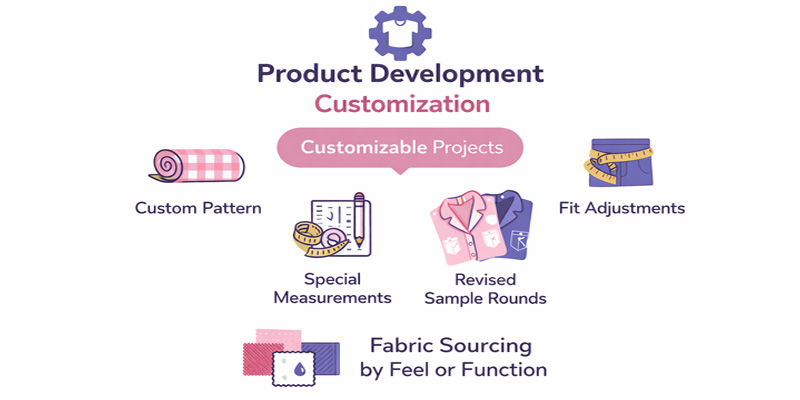
Layer 3: Product development customization
This includes:
- custom pattern
- fit adjustments
- special measurements
- revised sample rounds
- fabric sourcing by feel or function
At this point, the supplier is no longer just tagging a product. They’re helping build one.
For many new brands, I think the smartest path is somewhere in the middle:
- use a familiar pajama silhouette
- improve the fabric
- add private label details
- make packaging cleaner
- avoid overcomplicating the first order
That usually creates a much better balance of speed, cost, and brand identity.
For example, if I want to build a women’s sleepwear line, I might send the buyer toward women’s pajamas or one of the representative product pages. If the product line is broader, I’d link to custom pajamas and sleepwear products so the reader can explore other categories before requesting samples.
The best private label setup is not the most complicated one. It’s the one that makes the product feel branded, consistent, and realistic for the stage my business is in.
How Do Pricing, Samples, and Packaging Usually Work?
This is the part that makes private label feel real. Once I start talking about quotes, samples, and packaging, I’m no longer dreaming about a brand. I’m building one.
Private label pajama pricing usually depends on fabric, style complexity, MOQ, trims, printing, and packaging. Samples are often the first paid step, and packaging should be discussed early to avoid surprise costs later.
Here’s how I break it down in practical terms.
What affects price the most?
Usually:
- fabric type
- GSM
- print complexity
- trim details
- label setup
- packaging choice
- order quantity
A bamboo or modal pajama set with piping, custom labels, and upgraded packaging will not quote like a simple cotton basic set in a plain bag. And that’s okay. The key is clarity.
How samples usually work
Most factories will charge a sample fee. That fee often covers:
- pattern work
- cutting
- sewing
- trims
- handling
What I care about most is not whether the sample is cheap. I care whether it tells me something useful.
A sample should help me judge:
- fit
- fabric feel
- workmanship
- shrinkage risk
- print or trim accuracy
Why packaging should be discussed early
This gets ignored all the time. Then suddenly the buyer is close to production and realizes:
- custom bags cost more
- folded presentation changes packing method
- sticker/barcode requirements need time
- carton specs affect freight planning
I prefer to talk about packaging before final quote approval, not after.
That’s also why I like sending readers to how to choose a custom pajama manufacturer, because once pricing and sample details come up, supplier quality matters even more.
Good pricing conversations are not just about asking “how much?” They are about understanding what is included, what changes cost, and what will still matter after the product ships.
What Should I Ask Before Sending an RFQ?
A weak inquiry gets weak answers. I’ve seen that over and over.
Before sending an RFQ to a private label pajamas manufacturer, I should define my product type, target fabric, size range, MOQ goal, branding needs, and sample timeline. The clearer I am, the more usable the quote becomes.
If I’m writing an RFQ, I want to avoid vague messages like:
- “Can you make pajamas?”
- “What is your best price?”
- “Do you do private label?”
Those questions are too broad.
A better approach is to send a short but structured request.
My RFQ should cover:
- product category
- style type
- fabric composition
- target GSM
- color / print idea
- size range
- MOQ
- sample request
- labels
- packaging
- target market
- timeline
Example RFQ structure
- Product: Women’s long sleeve pajama set
- Fabric: 95% bamboo 5% spandex jersey
- GSM: around 200–220
- MOQ: 50 pcs per style per color
- Branding: neck label + care label + hangtag
- Packaging: custom polybag
- Sample need: yes
- Timeline: sample in 7–15 days if possible
- Market: US / EU
That level of detail tells the factory I’m serious, and it helps me compare replies properly.
If I’m still shaping the collection, I’d also cross-link to women’s pajamas manufacturer guide, because many private label buyers first need clarity on style and fabric before writing a useful inquiry.
The purpose of an RFQ is not to impress the factory. It’s to reduce confusion and speed up the path to a realistic quote.
How Can I Move From Idea to Sample Faster?
This is where momentum matters.
The fastest path from idea to sample usually comes from choosing a focused product direction, simplifying the first customization round, and sending one clean RFQ to the right factory instead of scattered messages to many suppliers.
I’ve noticed that many new brands slow themselves down by trying to decide everything at once.
They want:
- many styles
- many colors
- multiple fabrics
- detailed trims
- custom packaging
- aggressive pricing
- fast delivery
All in the very first order.
That sounds ambitious, but it usually creates delays.
If I want to move faster, I would do this:
Step 1: choose one product family
For example:
- women’s long sleeve set
- short sleeve short set
- bamboo lounge set
Step 2: keep the first version manageable
Use:
- one or two fabrics
- one trim direction
- one packaging method
- a simple brand identity system
Step 3: request one serious sample round
That gives me real feedback:
- fit
- handfeel
- workmanship
- market reaction
Step 4: improve before scale
That is where brand strength begins.
The reason this works is simple: speed does not come from doing more. It comes from reducing friction.
The first order should not try to prove everything. It should prove enough to justify the second order.
Conclusion
Private label pajamas are not just about adding a logo. They’re about building a product that feels like my brand, fits my budget, and makes sense for my stage of growth.
If I choose a manufacturer with the right level of flexibility, clear MOQ terms, workable sample process, and realistic packaging support, private label becomes much easier to manage.
That is what I want as a brand owner: not just a supplier, but a process I can actually use.