The Brand Owner’s Guide to Sourcing Custom Pajamas: Avoiding Sizing Errors, Fake Fabrics, and Delayed Shipments
I know exactly how stressful it is to launch a new pajama line. You have a beautiful vision for custom loungewear, but dealing with overseas factories makes your head spin. At Taian Lianchuang Textile Co., Ltd, I’ve seen countless brand owners exhausted by terrible communication and fake safety certificates. Grab a coffee, sit down, and let’s talk about how to fix your custom sleepwear supply chain once and for all.
To successfully source custom pajama sets, brand purchasers must partner with a transparent manufacturer that provides clear communication and verifiable fabric certifications. The most critical steps include requiring strict Tech Packs to eliminate sizing errors, independently verifying GOTS or OEKO-TEX certificates online, and establishing a milestone-based logistics timeline. Furthermore, buyers must accurately specify fabric blends, ensuring pure bamboo stretch jersey is explicitly labeled as 95% bamboo and 5% spandex, avoiding dishonest claims that destroy consumer trust.
Finding a sleepwear vendor on Google is incredibly easy, but finding a true manufacturing partner is rare. You need someone who won’t ghost you when production gets tough. Let’s break down the exact questions you should ask your next supplier to protect your business.
Why Do So Many Custom Pajama Orders Fail the Sizing Test?
We have all heard the nightmare stories. You approve a beautiful sample, pay your deposit, and wait. When the bulk pajamas finally arrive, the sleeves are too short, the pants are tight, and the sizing is a total mess.
Custom pajama orders frequently fail sizing tests because buyers rely on casual photos instead of formal Tech Packs, forcing factories to make unchecked assumptions. To prevent these disasters, buyers must establish a strict communication loop with a dedicated account manager and document every measurement, grading rule, and stitch type. Providing a detailed specification sheet ensures the factory understands standard Western sizing, eliminating the costly errors that occur when suppliers default to local templates.
I see this happen almost every single week. A new brand owner will send me an email with a screenshot they took from Instagram. They write, "I love this loungewear set. Can you make 500 of these for me in navy blue?"
I always have to take a deep breath and explain that a picture is not a manufacturing plan. If you do not have a Tech Pack, the factory is going to make a lot of wild assumptions. They will assume you want standard Asian sizing, which is significantly smaller than the North American, Australian, or European sizing your customers actually need.
Let me tell you a story about a buyer named Mark. Mark is a brilliant salesperson who knows exactly how to market his adult sleepwear. But a few years ago, before he came to Taian Lianchuang Textile, he nearly lost his entire business because of a massive communication breakdown with a different supplier.
Mark went to a tradeshow, shook hands with a friendly sales rep, and handed over a few photos of a pajama set he wanted to replicate. The sales rep smiled, nodded, and said, "Yes, my friend, we can do this! No problem." Mark felt great. He wired the deposit.
Two months later, the boxes arrived. Mark opened them up, and his heart sank. The sleeves on the Large and XL sizes were incredibly short. What went wrong? The problem was that Mark didn’t have a Tech Pack, and the sales rep didn’t ask the right questions. The rep just wanted the commission. When you don’t provide exact measurements for every single size, factories will not understand standard Western grading (how a garment correctly scales up in size). They just add a little width to the chest and completely ignore the arm length.
The Anatomy of Good Factory Communication
When you are sourcing for your brand, you need to set boundaries and expectations immediately. You cannot afford to lose days waiting for a simple email reply, especially when trying to perfect the fit of your garments.
Here is how you fix the communication gap: First, insist on a designated account manager who speaks your language fluently. Second, get them onto a faster platform if possible, or establish a guaranteed 24-hour response rule. Third, never assume they know what you mean. If you want a specific button, send a picture, write the size in millimeters, and state the exact material.
If you lack a professional Tech Pack, don’t panic. A responsible factory will help you build one. We take your rough idea and turn it into a standardized document that the sewing floor actually understands.
| Bad Factory Communication | Good Factory Communication |
|---|---|
| "Yes, we can make this exactly like the picture." | "We can make this, but we need your exact size chart and preferred fabric GSM first." |
| Replies 4 days later with no explanation. | Replies within 24 hours with an updated status report. |
| Ignores your questions about bulk consistency. | Provides a clear quality control plan before cutting begins. |
At the end of the day, you are not just buying clothes; you are buying peace of mind. You need someone on the ground in China who acts like your own employee. When you demand precise measurements for your custom loungewear production, you protect your margins and keep your customers happy.
How Can You Spot a Fake Organic Fabric Certificate Before Paying?
Nothing destroys a loungewear brand faster than selling "organic" pajamas that give your customers a skin rash. Fake certificates are a massive plague in the textile industry, and you need to protect your customers.
To spot a fake fabric certificate, brand owners must demand the factory’s unique GOTS or OEKO-TEX license number and verify it directly on the official public database. Accepting a simple PDF is highly dangerous because fraudulent suppliers easily alter these files. Buyers must confirm that the company name on the database perfectly matches the supplier they are paying, walking away from any factory that claims the certificate belongs to a mysterious partner mill.
Let’s have a real, honest chat about fabric fraud. It makes me incredibly angry because it hurts honest factories like ours, and it destroys trust with your customers. You are spending good money to build a premium adult clothing brand. You market your items as safe, sustainable, and organic. Then, some bad actor in the supply chain hands you a photoshopped piece of paper.
I see this happen constantly with organic cotton and eco-friendly fabrics. A purchaser will come to me, frustrated, holding a PDF certificate from their previous supplier. They ask, "Why did my customers complain about a harsh chemical smell if this is OEKO-TEX certified?" I take one look at the PDF, and the fonts don’t even match. It’s a complete fake.
The Dirty Secret of the Dye House
Your mistake is assuming that "organic cotton" automatically means a safe final garment. The raw cotton might be fine, but a dishonest factory will send the fabric to the cheapest dye house in their city to save a few pennies. That dye house will use harsh, uncertified chemical fixatives to make the colors stick.
This happens because buyers often fail to communicate their safety standards clearly. If you don’t explicitly forbid certain chemicals, a lazy supplier will use whatever is cheapest.
At Taian Lianchuang Textile, we control the entire process. We don’t just care about the yarn; we care about the dye. We use reactive dyes that are safe for the skin and friendly to the environment. If your sales rep cannot explain their dyeing process to you clearly, they are hiding something.
Doing the Legwork
So, how do you protect yourself from fake certificates? It is actually much easier than you think, but you have to do the work.
First, when a factory sends you a GOTS (Global Organic Textile Standard) certificate, do not just look at the logo. Look for the license number. Go directly to the GOTS public database on your web browser. Type that number in. Does the factory name pop up? Does the address match the factory you are dealing with? Is the certificate expired?
Often, a trading company will send you a certificate that belongs to a completely different fabric mill. They will say, "Oh, that is our partner." While this sometimes happens, it creates a massive blind spot for you. You have absolutely zero proof that they are actually buying the fabric from that certified mill. They could easily show you that certificate to win your trust, and then drive down the street to buy cheap, uncertified fabric.
Demand verifiable paperwork for your sustainable pajama sourcing. If a supplier makes excuses, walk away. There are plenty of honest factories out there who do things the right way.
Why is the "100% Bamboo" Stretch Fabric Claim a Complete Lie?
You want to create the most comfortable pajama set in the world, so you ask a factory for "100% bamboo" stretch fabric. The factory says yes, takes your money, and you end up selling a lie to your customers.
The claim of "100% bamboo" on stretch pajama sets is a physical impossibility that brands must actively avoid to prevent legal and compliance failures. To achieve the necessary stretch and recovery for comfortable sleepwear, pure bamboo stretch jersey must be explicitly identified as 95% bamboo and 5% spandex. If a supplier promises a stretchy 100% bamboo garment, they are providing dishonest information, which ultimately destroys consumer trust when the truth is revealed.
I have to be brutally honest with you because this specific lie trips up almost every new brand owner I meet. You want to create a beautiful, comfortable adult pajama set that moves with the body.
You go to a factory and say, "Make this stretchy jersey out of 100% bamboo." The sales rep nods and says, "Yes, my friend, no problem!" They know it sounds pure, natural, and highly marketable to your audience.
The Science of Stretch Recovery
Here is the truth from someone who has been manufacturing clothes for two decades: bamboo fibers alone do not have the elasticity required to stretch and recover. If you make a knit shirt out of purely bamboo, the moment you put it on and bend your elbows, the fabric will bag out and lose its shape entirely. It will look terrible after one wear.
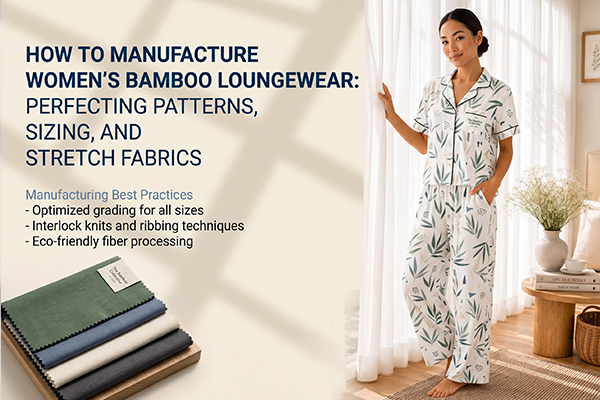
To get that buttery soft, flexible jersey knit that drapes beautifully on the adult body, you absolutely need spandex. Specifically, our pure bamboo stretch jersey is exactly 95% bamboo and 5% spandex.
When a factory tells you it is 100% bamboo, they are just telling you what they think you want to hear to close the deal. And when your savvy customers read the care label, or when customs agents test the fabric at the border, the truth comes out. Your customers won’t blame the factory in China; they will blame you. They will think you are a liar.
Enforcing the 95/5 Rule
Honesty in your material blends is absolutely non-negotiable. It builds a foundation of trust that keeps buyers coming back to your store year after year.
You must strictly instruct your factory to list accurate fabric compositions on all labels and Tech Packs. We strictly enforce this accurate labeling because we respect you and your end consumer. When you demand this level of exact detail for your custom bamboo sleepwear, the factory knows they are dealing with a professional, and they will respect your business. Never let a supplier talk you into printing a lie on your care tags.
What Are the Real Safety Standards When Adding Kids Pajamas to Your Line?
Many adult sleepwear brands eventually want to launch matching family sets. It is a great business move. But if you treat a baby’s sleep sack the same way you treat an adult’s pajama top, you invite recalls and lawsuits.
Strict age classification is critical when manufacturing family sleepwear collections. Infant clothing applies exclusively to sizes 0-24 months, requiring the highest safety scrutiny regarding choking hazards, snaps, and skin sensitivities. Children’s clothing applies strictly to ages 2 years and older, where mobility and seam durability become the focus. Manufacturers must apply different compliance standards and CPSIA regulations based precisely on this 0-24 months versus 2 years and older breakdown.
I cannot stress this enough: if your factory treats a 6-month-old’s bodysuit the same way they treat a 4-year-old’s pajama set, you are in serious trouble. The physical needs, safety risks, and legal regulations are entirely different.
Many buyers I meet know how to sell and how to manage a business, but they lack a deep technical understanding of safety regulations. You absolutely must understand the technical and legal definitions of your target audience to protect your brand.
The 0-24 Months Rule: Infants
When we talk about infants or babies, we are referring strictly to the 0 to 24-month age range. This is the most heavily regulated category in the apparel industry, especially for North America, Australia, and Europe.
Why? Because babies put everything in their mouths. They have incredibly delicate skin that absorbs chemicals rapidly. They cannot untangle themselves if a string gets wrapped around their neck.
For the 0-24 months category, every single component is under a microscope. Snaps must pass strict pull-tests to ensure they won’t detach and become choking hazards. Drawstrings around the neck are completely illegal in many regions. The fabrics must be rigorously tested for lead, phthalates, and flammability. If your supplier doesn’t proactively discuss these CPSIA or EU safety standards with you, they are putting your business at immense risk.
The 2 Years and Older Rule: Children
When we mention children or kids, we are referring exclusively to ages 2 years and older. While safety remains a top priority, the focus shifts slightly.
A 3-year-old is running, jumping, and scraping their knees. For the 2 years and older category, we start looking harder at the durability of the fabric, the strength of the seams, and how well the garment holds up after fifty trips through the washing machine.
While you still need safe dyes and lead-free zippers, you have a bit more freedom with design. You can incorporate more complex trims, different types of buttons, and fabrics that prioritize stretch and movement. You would be amazed at how many cheap factories use the exact same trims and sewing techniques for a 3-month-old as they do for a 5-year-old just to save a few pennies. When you expand your brand to include matching family apparel, make sure your factory respects these legal age lines.
How Do We Guarantee Your Pajamas Ship Before the Winter Season?
The pajamas are sewn beautifully, but November is approaching, and your winter inventory is still sitting in a warehouse in China. Delayed shipments will absolutely destroy your sales season. Let’s fix your timeline.
To guarantee on-time shipments, brands must enforce strict, milestone-based production schedules with their custom pajama manufacturers. This schedule must include firm deadlines for fabric purchasing, sample approval, cutting, sewing, and final AQL inspection. By requiring weekly progress updates from a fluent account manager, brands can identify potential delays early and adjust their logistics, ensuring seasonal sleepwear collections arrive exactly when needed.
I hate hearing stories about brands missing their holiday sales window. It is heartbreaking. You spend months designing, marketing, and hyping up your audience. You pay for ads. You get your website ready. And then… the factory says, "Sorry, my friend, the fabric mill was late. We need three more weeks."
By the time the clothes arrive by ocean freight, the winter season is over. You are left with thousands of dollars in inventory that you now have to put on clearance just to get your money back.
Why does this happen? It happens because most factories are terrified of losing your order, so they lie to you about the timeline. They will tell you they can finish in 30 days, knowing full well it will take 60.
The Transparent Production Timeline
At Taian Lianchuang Textile, we do not play that game. If your order requires 45 days, I will tell you it takes 45 days. I would rather lose your order because I was honest about the timeline than ruin your business by delivering late.
To protect yourself from delays, you must build buffers into your schedule, and you must hold the factory accountable at every single step. Don’t just ask, "Is it done yet?" You need to know the specific milestones.
You should know exactly what week the fabric arrives at the facility. You should know what week the cutting happens. You should know what week the sewing starts. If the fabric is delayed by three days, your account manager should tell you immediately, not wait until the final shipping day to break the bad news.
Quality Control and Final Inspections
Speed means nothing if the quality is garbage. When factories rush because they are behind schedule, that is when the sewing gets crooked and the loose threads appear.
This is why you must demand a clear Quality Control (QC) process. Before we ship anything to North America or Europe, we do inline inspections (checking the garments while they are being sewn) and a final AQL (Acceptable Quality Limit) inspection before packing. If you want to hire a third-party inspector for your custom pajama order, we welcome them. It proves to you that we did exactly what we promised.
Conclusion
Building a custom pajama brand shouldn’t be a nightmare. By demanding accurate fabric blends, verifying your certificates, respecting age safety standards, and enforcing strict timelines, you protect your business. Let’s make your next sleepwear collection a massive success together.