Many overseas brands work with China pajama manufacturers to develop custom sleepwear, private label pajamas, loungewear, and seasonal collections. China offers broad fabric sourcing and production capabilities, but brands should check much more than the unit price before selecting a factory.
Before choosing a China pajama manufacturer, overseas brands should check the factory’s sleepwear experience, fabric knowledge, MOQ, sample process, private label capabilities, quality control, communication, production timeline, and shipping planning. The supplier should be able to explain fabrics, GSM, printing, sizing, labels, packaging, and sample revisions clearly. A suitable factory should also understand the brand’s target market and help turn the initial product idea into stable, production-ready sleepwear.
The right manufacturer should support product development, not only provide a low unit price. Before requesting quotations, brands should prepare clear product information and understand which parts of the project may affect cost, MOQ, and lead time.
Why Do Overseas Brands Work With China Pajama Manufacturers?
China has a large textile and apparel supply chain, which allows overseas brands to develop different sleepwear products within one manufacturing system.
A China pajama manufacturer may support fabric sourcing, pattern development, sample making, custom printing, private labels, packaging, and bulk production. This can be useful for both startup brands testing their first collection and mature brands looking for a second or backup supplier.
Overseas brands often work with Chinese factories because they need:
- custom manufacturing experience
- access to different knit and woven fabrics
- sample development support
- private label options
- small batch or low MOQ production when available
- several sleepwear categories from one supplier
- long-term collection development
Brands in the United States, Australia, Europe, the Middle East, and South America may have different sizing, labeling, seasonal, and compliance needs. A useful manufacturer should therefore ask about the target market instead of treating every order in the same way.
For example, an Australian summer pajama line may need lighter fabrics and a different launch schedule from a European fall/winter collection. A Middle Eastern brand may focus on modest silhouettes or breathable lounge sets, while a U.S. family pajama program may require more detailed children’s product planning.
The advantage of working with one experienced supplier is not only production. It is also the ability to build repeatable fabrics, fits, colors, labels, and packaging across future collections.
What Types of Pajamas Can a China Manufacturer Produce?
A China pajama factory can usually develop several related sleepwear categories. However, each product type requires different fabric, fit, size grading, printing, and sewing decisions.
Common categories include:
- women’s pajama sets
- men’s pajama sets
- kids pajamas
- bamboo pajama sets
- modal pajama sets
- satin pajama sets
- linen sleepwear
- loungewear sets
- maternity and nursing sleepwear
- matching family pajamas
- holiday and seasonal pajamas
- private label sleepwear
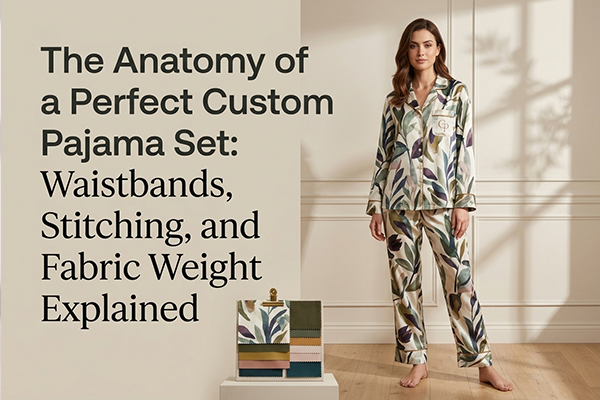
For women’s collections, buyers may develop button-up sets, long sleeve pajamas, short sets, wide-leg pants, nightgowns, and soft lounge-inspired products. Brands can review custom women’s pajamas and different women’s pajama sets before preparing a sample brief.
Men’s products may include classic collared sets, lounge pants, Henley tops, robes, linen sleepwear, or French terry lounge sets. These directions can be compared through custom men’s pajamas and related men’s pajama sets.
Kids products need more careful size grading, labeling, print review, and target-market compliance planning. Brands can use custom kids pajamas or kids pajama sets as category references.
Brands expanding beyond bedtime products may also develop custom loungewear sets or private label loungewear sets for home, travel, and casual daily use.
A factory that offers many categories should still be able to explain the technical differences between them. Product range alone does not prove production expertise.
How Should Brands Check Whether a China Pajama Factory Is Suitable?
Supplier evaluation should focus on practical capabilities rather than website claims alone.
First, check whether the supplier has real experience in sleepwear and loungewear. A factory that understands pajamas should be able to discuss collars, piping, waistbands, cuffs, relaxed fits, shrinkage allowance, and fabric recovery.
Second, ask whether the supplier can explain fabric and GSM clearly. The sales team should understand how fabric weight affects drape, warmth, opacity, stretch, and cost.
Third, review the sample process. Ask:
- Who develops the pattern?
- Can the factory work from a tech pack or reference sample?
- How are fit comments handled?
- How many revision rounds may be needed?
- Can wash testing be arranged before bulk production?
The supplier should also give clear information about MOQ, sample time, bulk production time, private labels, and packaging.
Communication quality matters as well. Good communication does not mean replying “yes” to every request. A reliable supplier should identify unclear details, explain possible risks, and offer practical alternatives.
Brands can use this pajama factory guide when choosing a pajama factory. It is also useful to understand how to verify a real custom sleepwear manufacturer before comparing prices.
A low quotation is not useful if the fabric is unstable, the fit is wrong, or communication becomes unclear after the deposit is paid.
What Should Brands Ask About MOQ, Samples, and Lead Time?
MOQ is affected by more than the number of finished garments. Fabric availability, colors, prints, trims, labels, and packaging can all change the minimum order requirement.
Stock fabric may support lower quantities because the material is already available. Custom-dyed, custom-knitted, or exclusive printed fabric may require a higher MOQ.
Low MOQ can help startup brands test:
- one core style
- two or three colors
- one main fabric
- one print direction
- a limited size range
However, lower MOQ often means a higher unit price because sample, cutting, material preparation, and production setup costs are divided across fewer garments.
Sample time depends on:
- fabric availability
- pattern development
- custom print testing
- trim sourcing
- embroidery
- size sample requirements
- revision rounds
Bulk lead time depends on the final quantity and customization level. Brands should confirm that the approved sample, fabric, labels, packaging, and payment schedule are all included in production planning.
Holiday and seasonal collections should start earlier. A family Christmas pajama line, for example, may need coordinated adult and kids sizing, custom prints, packaging, and additional testing.
There is no universal MOQ or production timeline for every project. Brands should review minimum order quantities in pajama manufacturing and understand how MOQ affects pajama production before comparing offers.
A private label pajamas manufacturer may also help startups plan more manageable low MOQ private label pajamas.
How Should Brands Confirm Fabric, GSM, and Print Method?
Fabric should be confirmed by specification and sample, not only by a general name.
Common sleepwear materials include:
- bamboo cotton
- bamboo viscose with spandex
- modal or TENCEL modal
- organic cotton
- cotton poplin
- satin
- linen or linen-cotton blends
- rayon
- rib knit
- French terry or fleece
Brands should ask for:
- exact fabric composition
- GSM or fabric weight
- knit or woven structure
- hand feel
- stretch and recovery
- shrinkage result
- colorfastness
- pilling performance
- print compatibility
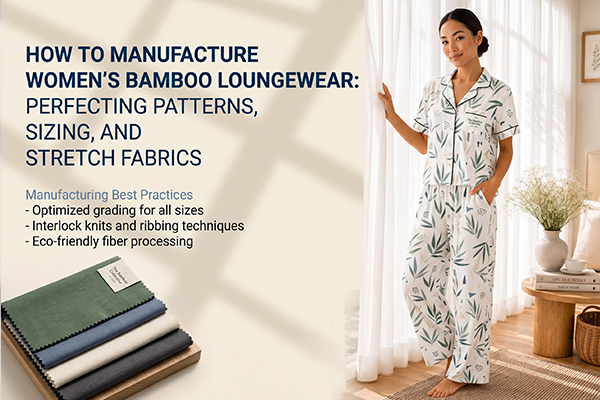
Bamboo cotton and bamboo viscose blends are often used for soft pajama sets. Brands looking for this category can review the custom bamboo pajama manufacturer guide and compare different bamboo pajama fabric directions.
Modal may support smoother drape, while organic cotton is often chosen for a more familiar natural-fiber position. Satin works for lightweight woven women’s sets, linen supports relaxed resort-style sleepwear, and French terry or fleece is more suitable for structured loungewear.
Brands can compare broader custom pajama fabric options and sleepwear fabric options before approving samples.
Common decoration methods include:
- digital printing
- screen printing
- all-over printing
- placement printing
- embroidery
- yarn-dyed stripes
The method should match the fabric, artwork, quantity, hand-feel target, and washing requirements. Stretch fabrics should be tested because fine lines or motifs may change when the garment is worn.
What Private Label Options Can a China Pajama Factory Support?
Private label details turn a basic garment into a complete branded product.
Common options include:
- woven labels
- printed neck labels
- size labels
- care labels
- hang tags
- branded poly bags
- custom packaging
- custom buttons
- drawstrings and trims
- logo embroidery
- custom print placement
The care label should reflect the actual fiber composition and suitable washing instructions. The placement of labels should also be confirmed during sampling, especially for soft sleepwear and kids products.
Startup brands do not need every custom option in the first order. One label system, one hang tag, and one packaging direction may be enough for a professional first collection.
Too many custom buttons, trims, packages, and print placements can increase development time, cost, and approval work. More advanced branding details can be added after the core product has been tested.
How Can Brands Check Quality Before Bulk Production?
Quality control should begin before bulk production, not only at final inspection.
Brands should first approve the fit sample. The approved sample should confirm:
- product shape
- measurements
- fabric
- colors
- trims
- labels
- print or embroidery
- packaging direction
If a custom color is used, brands may need to approve a fabric swatch or lab dip. Printed products may require a strike-off or print sample before full fabric production.
Important quality checks include:
- shrinkage after washing
- colorfastness
- pilling where relevant
- stretch recovery
- size chart and tolerance
- sewing quality
- print clarity
- label placement
- packaging accuracy
A pre-shipment inspection may be arranged when the brand needs an additional check before goods leave the factory.
Children’s sleepwear requires special attention. Brands should confirm local safety, flammability, labeling, and testing requirements with qualified laboratories or regulatory professionals in the target market. Requirements may depend on garment size, fit, intended use, and how the product is marketed.
How Should Overseas Brands Plan Shipping and Launch Timing?
Shipping should be planned together with production, not after production is finished.
Air shipping is faster but usually more expensive. It may be useful for samples, small urgent quantities, or part of a launch order.
Sea shipping is slower but can be more suitable for larger production orders. Brands need to include port handling, customs clearance, inland delivery, and possible delays in their launch plan.
The final schedule should include:
- product brief confirmation
- fabric and trim sourcing
- first sample
- sample revisions
- final approval
- bulk production
- quality inspection
- shipping
- customs clearance and local delivery
Holiday and seasonal launches need more time because missing the selling period can create a much larger problem than paying a slightly higher production cost.
Delays can also happen when artwork, sample comments, packaging files, or payment confirmation arrive late. Clear approval deadlines help both the brand and factory keep the project moving.
What Information Should Brands Prepare Before Requesting a Quote?
A useful quotation depends on clear project information.
Brands should prepare:
- target country or market
- product type
- reference images
- tech pack, if available
- preferred fabric
- GSM, if known
- size range
- color plan
- print or logo artwork
- estimated order quantity
- label requirements
- packaging requirements
- launch date
- testing or compliance needs
- budget range, if available
A complete tech pack is helpful, but it is not always required for the first discussion. Clear reference images, basic measurements, fabric direction, quantity, and branding requirements can still help the manufacturer provide early suggestions.
The clearer the request, the easier it is for the China pajama manufacturer to explain suitable fabrics, expected MOQ, sample requirements, and possible cost drivers.
How to Build a Long-Term Relationship With a Pajama Manufacturer in China?
A strong manufacturing relationship usually develops through repeatable processes rather than one large first order.
Start with a focused collection. One or two core styles are easier to review than a launch containing many unrelated fabrics and silhouettes.
Give clear sample comments. Instead of saying “the fit is not right,” explain which measurement or area should change.
Confirm fabric, size, and label details early. Last-minute changes can affect both cost and delivery.
Keep communication organized. One approved document for measurements, colors, labels, packaging, and artwork reduces confusion.
Plan seasonal collections in advance and review feedback after each order. Customer comments about fit, shrinkage, hand feel, or packaging can help improve the next production round.
Brands can also build repeatable core styles. A successful women’s pajama set may return in new colors or prints instead of being redeveloped from zero each season.
The best long-term approach is to use the manufacturer as a development partner, not only as a price supplier.
Conclusion
Choosing a China pajama manufacturer is not only about finding the lowest unit price. Overseas brands should compare fabric knowledge, sample support, MOQ, private label options, quality control, communication, production timing, and shipping planning. Clear product information helps the factory provide better fabric suggestions, sample plans, and quotations. A focused first collection also makes it easier to test quality and build a stable long-term supply relationship. Brands ready to begin can request a pajama production quote, discuss your custom pajama project, or contact our team.